Where to start with AI in a MedTech company: one process first
Start with the one process closest to revenue, measure it, fix the flow, then add AI step by step — a MedTech playbook built on Deloitte, McKinsey, BCG and MIT data from 2025–2026.
Start with one process — the one closest to revenue — and make it work with AI before you touch anything else. Not a strategy, not a platform, not a tool rollout: one process, measured before and after, fixed first, then given to software one stage at a time. The evidence for that order is now hard to argue with. In Deloitte’s May 2026 survey of 100 MedTech leaders, 57% said AI in their company is used mainly to make individuals a little faster, with little change to how the work actually flows; only 6% had redesigned a workflow around people and AI working together, although 27% said that was the ambition.¹ The gap between those two numbers is where most MedTech companies are standing today — and it is the gap this article is about closing.
Researched and drafted with AI assistance; reviewed, fact-checked and edited by Primož Verbič.
In brief
- Most MedTech companies already use AI and have changed nothing. Deloitte (July 2026) found 57% use it for individual productivity with little process change; one in three use AI outputs informally, with no updated procedure or validation step.¹
- The companies that get value redesign the work, not the tooling. McKinsey & Company (November 2025) found that the 6% of “high performers” are nearly three times as likely as everyone else to fundamentally redesign workflows; only 39% of all respondents can attribute any EBIT impact to AI.²
- The cost of waiting is a widening gap, not a missed trend. Boston Consulting Group (BCG, September 2025) reports that the 5% of “future-built” companies show 1.7 times the revenue growth of the 60% who see minimal gains — and that 70% of AI’s value sits in core functions such as sales, marketing and supply chain.³
- Most attempts fail for process reasons, not model reasons. MIT’s NANDA initiative (August 2025) found 95% of enterprise pilots show no measurable P&L impact, and attributes it to a workflow-integration and learning gap.⁴ Gartner predicted at least 30% of GenAI projects abandoned after proof of concept by end-2025, citing data quality, risk controls, cost and unclear value.⁵
- The method that works is small and sequential: pick one process, baseline it, fix the flow, add assistants, automate the hand-offs, then — and only then — let an agent run the routine cases, with a named human accountable throughout.
Where are MedTech companies actually with AI today?
The honest picture is not “behind”. It is “busy, and unchanged”. In Deloitte’s survey, 45% of MedTech leaders said they had agentic AI in production, yet 90% of them said fewer than 15% of their workflows had been materially transformed by it.¹ A third said AI outputs are used informally — no updated SOP, no validation step — which in a device company is a quality-system exposure, not an efficiency statistic.
The field looks the same. A 2026 survey of MedTech sales representatives cited by MedTech Intelligence found 36% use AI, almost entirely for drafting emails and summarising meetings; 60% of non-users said their company prohibits it.¹⁰ Prohibition does not stop use. Microsoft and LinkedIn’s 2024 Work Trend Index, across 31,000 workers, found 78% of AI users bring their own tools to work and 60% of leaders admit they have no plan for AI.⁸
So the typical MedTech company in 2026 already has AI in it — unmanaged, individual, invisible to the quality system and absent from the one place it would compound, which is the flow of work between people. That is not a reason for alarm. It is the starting point, and the ingredients are already in the building.
What to do this week: ask five people in sales, marketing and service what AI tools they used last week and for what. Write it down. That list is your real as-is map.
Why “we will scale first and add AI later” stopped being a plan
Until recently a growth-stage device company could reasonably grow on headcount and process discipline and leave automation for later. Two things have changed. First, the gap between companies that have rewired work around AI and those that have not is now measurable and widening. BCG’s 2025 study of 1,250 executives sorts companies into 5% “future-built”, 35% “scalers” and 60% “laggards” who report minimal gains despite investment; the first group shows 1.7 times the revenue growth and 1.6 times the EBIT margin of the third.³ McKinsey’s November 2025 survey of 1,993 respondents says the same from another angle: 88% of organisations use AI somewhere, only 39% see any EBIT effect, and the 6% who see a material one are distinguished less by what they bought than by having redesigned how work gets done.²
Second, our sector has started but not finished. McKinsey’s MedTech practice found in May 2025 that two-thirds of MedTech companies were implementing generative AI — half still piloting — and only 15% could report a positive P&L effect.⁹ The competitive question is not whether a competitor will use AI, but how long it takes them to get one process to compound — and whether you get there first.
I wrote about what this means for headcount and organisation in More revenue, fewer people. This article answers the question readers of that piece asked most: where, concretely, do we begin?
What to do this week: name the one process where more volume would hurt most — lead-to-quote, order-to-installation, complaint-to-closure. That is the process. Everything below applies to it alone.
Why most first attempts fail — four traps
The failure data is consistent enough to be useful. Each trap below has a step of the ladder designed to avoid it.
Trap one: buying before mapping. Gartner’s four reasons for abandoned projects — weak data, insufficient risk controls, rising cost, unclear business value — are all symptoms of starting with a tool and looking for a problem.⁵ A company that has never written down how a quote moves from enquiry to signature cannot specify what software should do to it.
Trap two: individual tools, no process change. This is the Deloitte 57%.¹ A rep who drafts emails faster inside a flow that still waits four days for a configuration approval has changed nothing the customer can feel. MIT’s 95% is this trap at enterprise scale; the report blames a learning gap between tools that do not adapt to the workflow and organisations that do not adapt the workflow to the tool.⁴
Trap three: trusting AI outside the line where it is good. A Harvard Business School field experiment with 758 BCG consultants in 2023 found that on tasks inside AI’s capability people completed 12.2% more work, 25.1% faster, at more than 40% higher quality — and on tasks just outside it, people using AI were 19 percentage points less likely to reach a correct answer.⁷ The line is jagged and invisible from inside the task. In a regulated business that is the whole argument for a named human at defined points.
Trap four: no baseline, so no proof. Without a before-number, a successful pilot is an anecdote and a failed one is a rumour. Deloitte found more than a third of MedTech companies measure AI value inconsistently or not at all.¹ Nobody can defend the budget for step four when step two was never measured.
The ladder: one process, six steps
The method is a ladder, not a programme. Each step is small enough to start inside two weeks, has an exit metric, and avoids one of the traps above. You do not climb to the next step until the current one is measured.
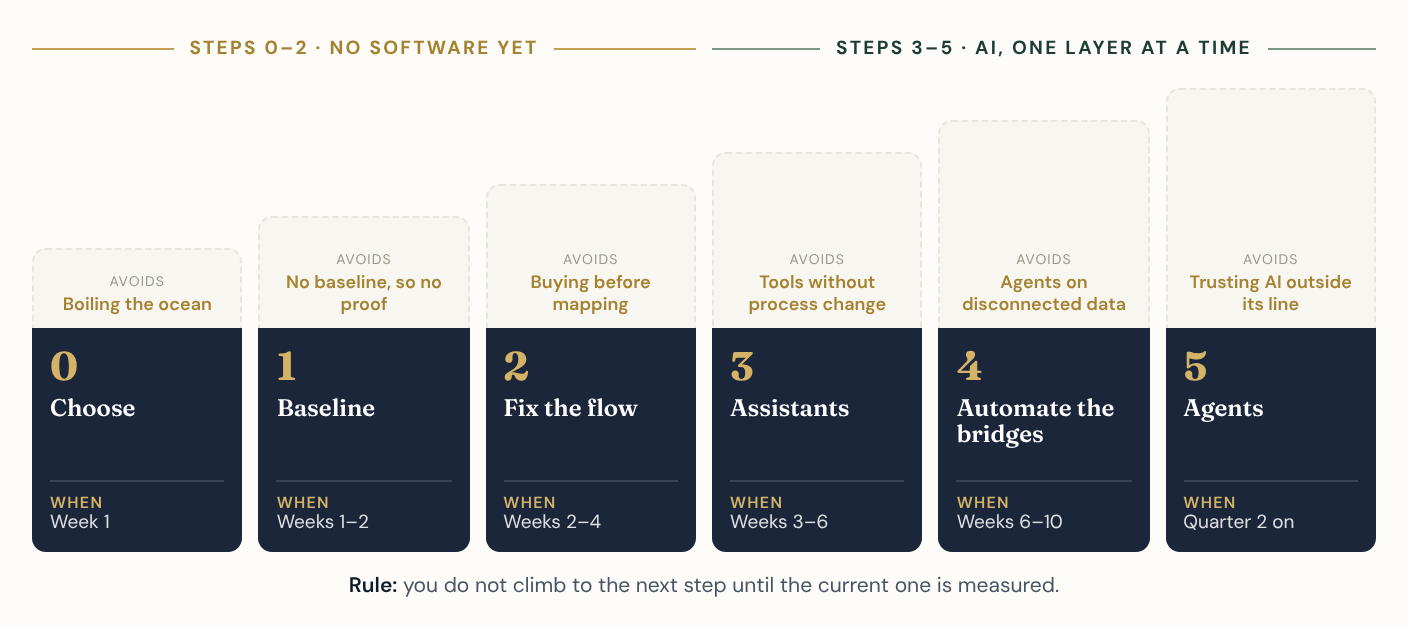
| Step | What you do | Timebox | Exit metric | Trap it avoids |
|---|---|---|---|---|
| 0 · Choose | One process, start event to end event, one accountable owner, the three to six people who do the work in the room | Week 1 | A one-line charter signed by the owner | Boiling the ocean |
| 1 · Baseline | Follow five real cases through the process; record who touched them, in which system, how long each step waited | Weeks 1–2 | Cycle time, wait time, right-first-time rate, hand-off count, written down | Trap four |
| 2 · Fix the flow | Remove, merge and reorder steps before any software; kill the duplicate entry and the approval nobody needs | Weeks 2–4 | Hand-off count down; the same five cases re-run on paper | Trap one |
| 3 · Assistants | Give the people in the process an assistant for the drafting, summarising and searching that remains; they review every output | Weeks 3–6 | Hours per case down; override rate recorded | Trap two, trap three |
| 4 · Automate the bridges | Connect systems where a human manually re-types, re-keys, or re-enters the same data; every “swivel-chair” moment becomes an integration | Weeks 6–10 | Re-keying steps at zero; error rate at entry down | Trap one, its data half — agents on disconnected data |
| 5 · Agents | Let software run the routine 80% of cases end to end and escalate the rest to a named person with full context | Quarter two onwards | Straight-through rate; escalation rate; audit log in place | Trap three |
Three things about the order matter more than the detail.
The flow is fixed before AI touches it. Step two has no software in it. This is where companies lose patience, and it decides everything after it, because automation applied to a wasteful process produces faster waste at higher cost. The companies that reach value in BCG’s data are those that “reshape workflows and roles rather than only automating existing tasks”.³
Assistants before automation, automation before agents. The difference is who acts: an assistant answers a person, who reads the output and decides; an agent handles a case, running the steps across your systems and escalating only the exceptions. An assistant keeps a person in every loop, which is the cheapest way to learn where the jagged line runs in your process. Only once you know where the AI is reliably right do you remove the person from that step — from that step, not from the process.
Every step produces a number the sponsor can read. The baseline is the asset. It turns step three from “the team likes it” into “hours per quote fell from 3.4 to 1.9 and the override rate is 12%”, and it earns the budget for step four. If you cannot measure a step, you are not on it yet.
In my own practice the first three steps are a fixed-fee, two-week engagement — the Scale Diagnostic — and steps four and five run with the client’s team over a quarter. But the method does not depend on an advisor. It depends on the owner, the doers and the baseline, and all three are already in your company.
What this looks like in a device company
A medical-device business cannot copy the consumer-software version of this. Four rules keep the ladder inside the quality system rather than beside it.
- A named human is accountable for every step, including the automated ones. Software can be responsible for a step; a person is always accountable for its outcome. One name per step, written in the procedure.
- The procedure states what the AI does, what the human checks, and who signs. Deloitte’s “one in three use AI outputs informally” is the thing an auditor will find first.¹ An assistant that drafts a complaint acknowledgement is fine; an undocumented one is not. If the step touches a controlled process, the tool is validated before use — I covered what that means in practice under ISO 13485:2016 in AI agents and ISO 13485.
- No regulated or confidential company data goes into a consumer tool. Technical documentation, complaint records, pricing, customer contracts, tender submissions — enterprise terms or nothing. (The commercial and operational processes this article covers should not hold patient data at all; if one does, that is a finding for the quality system, not a tooling question.) This is also the honest answer to the 60% of sales teams whose companies “prohibit AI”: the problem is unmanaged tools, and the solution is sanctioned ones, not prohibition.¹⁰
- Track the override rate. The share of AI outputs a human changed before use is the single most informative number on the ladder. Near zero means either the AI is excellent or nobody is checking. In a device company you need to know which.
What carried the growth before AI existed
I spent ten years building the Spanish market for a diagnostic device from a non-Spanish manufacturer nobody here had heard of, and by the end it was in roughly 80% of public primary-care clinics and in many hospitals, public and private, with about 90% market share in its category. Not one step of that was done with AI; the tools did not exist. What carried it was a sequence that never changed from one region to the next: research the customer, research the buying team, build the health-economic case, present it in the same structure every time, run a pilot, train in the same structure every time. The moment that decided the business was when we noticed that presentations, demonstrations and pilots turned into orders at a rate we could predict. From then on we ran the sequence as if it were written down — it was in our heads before it was on paper — and that is when we could scale, because a routine can be taught to a new rep and a one-off cannot.
The bottlenecks were never the human moments. They were the desk work around them: market studies, clinical desktop research, competitor studies, and the training and evaluation of the sales force. For the first five years that training depended on one trainer, then two, then three — and even at three, keeping a team of around 30 people across five to seven distributors trained and evaluated to the same standard was the hardest operational problem we had. If I were running that flow today, I would hand all of that research to AI in the first month, together with part of the sales-force training and evaluation and the competitor monitoring — and I would not touch a single step where a person talks to a person: the conversation with the head of the centre, the demonstration, the pilot review, the negotiation. The point is the order. The flow was repeatable before it was automatable, and that is why AI would compound on it rather than hide its weaknesses.
What to do first
If you run a mid-sized producer: choose the process and name the owner this week — the one decision that cannot be delegated. Give the owner two weeks and five real cases for the baseline, and approve no AI licence for that process until step two is done. Expect the baseline to be uncomfortable; the number most leaders have never seen is how long their own quotes spend waiting.
If you lead a distributor: your highest-value process is almost always the one between the manufacturer’s information and the hospital’s question — product data, availability, documentation, tender paperwork. Baseline the time from “hospital asks” to “hospital has the answer”. An assistant over your own product documentation, with a person checking every answer, is the most defensible step three in the sector, and where the distributor’s role as knowledge partner becomes real.
The one-page ladder
PDF · A4 · 1 page · no sign-upThe six steps, the exit metrics and the four device-company rules on one page, to print and put on the wall.
For both: if you would like a second pair of eyes on which process to start with, the AI-native Scale Scorecard is the ten-minute self-assessment I use with clients, free, and you keep the result. If a conversation would be helpful after that, let me know.
A note on scope
This article is about AI in the organisation — sales, marketing, service, operations and the quality processes around them. It is not about AI inside the device. Software that is part of a medical device, or that makes clinical decisions, falls under Regulation (EU) 2017/745 (MDR) and Regulation (EU) 2024/1689 (the AI Act), with its own classification, conformity and documentation obligations; nothing above applies to it. The ladder is for the work your people do around the product.
Common questions
Where should a medical device company start with AI? With one process, not a strategy. Pick the process closest to revenue where more volume would hurt most — usually lead-to-quote, order-to-installation or complaint-to-closure — measure how it runs today across five real cases, fix the obvious waste in the flow, and only then add AI, starting with assistants that keep a person in every loop. Deloitte’s 2026 data shows most MedTech companies skip the first three steps, which is why only 6% have redesigned a workflow despite near-universal AI use.
Do we need to fix our process before using AI tools? Yes, and it is the step most companies skip. Automation applied to a wasteful process produces faster waste at higher cost. McKinsey’s 2025 survey found the companies seeing material EBIT impact from AI are nearly three times as likely to have fundamentally redesigned workflows, and MIT’s 2025 analysis attributes the 95% pilot failure rate to workflow integration, not model quality. “Workflow integration” means four practical things that have nothing to do with how clever the model is: the tool is connected to the systems where the work lives (CRM, ERP, document store) instead of sitting in a separate browser tab; the procedure says at which step it is used, what it produces and who checks the output; the people who do the work were trained on it and had a say in where it goes; and someone owns it, measures it and fixes it when it drifts. A pilot that lacks those four never becomes part of how the company works — the model could be perfect and the result would be the same.
How long does the first step take? Two weeks for the first three steps — choosing the process, measuring a baseline across five real cases, and fixing the flow on paper — if the owner and the people who do the work are in the room. The first assistant can be live by week three. Agents running cases end to end belong in the second quarter, after the baseline has proved where the AI is reliably right.
Is it safe to use AI in a regulated medical device business? Yes, if the organisation does four things: a named human accountable for every step, a procedure that states what the AI does and who signs, no regulated or confidential company data — technical documentation, complaint records, pricing, customer contracts — in consumer tools, and a recorded human-override rate. Deloitte found one in three MedTech companies use AI outputs informally with no updated SOP or validation step — that is the risk, and it is organisational, not technological.
What if our team is already using ChatGPT unofficially? Then you are normal: Microsoft and LinkedIn’s 2024 Work Trend Index found 78% of AI users bring their own tools to work. Treat it as free discovery — ask what they use it for, because that list is your map of the repetitive work — then replace the unsanctioned tools with sanctioned ones. “Sanctioned” has a precise meaning: a tool the company has approved for named uses, on an enterprise contract that excludes your data from model training and gives you access control and an audit log, with a named owner, and listed in a one-page AI policy that says what may and may not go into it. In practice that is the business or enterprise tier of a general assistant (Claude, ChatGPT, Microsoft 365 Copilot), the AI built into the CRM or service desk you already pay for, or a tool validated for a controlled process. A personal account on the free tier is not sanctioned, however good the model. Prohibition does not stop the use; it only hides it from the quality system.
Model concept / all quotations attributed as reported by the linked publication; all other source material is paraphrased.
Sources
- Deloitte Center for Health Solutions, Medtech’s agentic AI moment: Turning ambition into enterprise advantage, 30 July 2026 (survey of 100 MedTech leaders, May 2026).
- McKinsey & Company, The state of AI in 2025: Agents, innovation, and transformation, 5 November 2025 (1,993 respondents, 105 countries).
- Boston Consulting Group, AI leaders outpace laggards with 1.7x revenue growth — The Widening AI Value Gap: Build for the Future 2025, 30 September 2025 (1,250 executives).
- Fortune via Yahoo Finance, MIT report: 95% of generative AI pilots at companies are failing, 18 August 2025, reporting MIT NANDA, The GenAI Divide: State of AI in Business 2025.
- Gartner, Gartner Predicts 30% of Generative AI Projects Will Be Abandoned After Proof of Concept By End of 2025, 29 July 2024.
- Brynjolfsson, Li and Raymond, Generative AI at Work, NBER Working Paper 31161, April 2023; published in The Quarterly Journal of Economics 140(2), 2025 (5,179 customer-support agents).
- Dell’Acqua et al., Navigating the Jagged Technological Frontier, Harvard Business School Working Paper 24-013, 22 September 2023 (758 BCG consultants).
- Microsoft and LinkedIn, 2024 Work Trend Index Annual Report: AI at Work Is Here. Now Comes the Hard Part, 8 May 2024 (31,000 workers, 31 markets).
- McKinsey & Company, Strategies for scaling generative AI in medtech, 29 May 2025 (40 MedTech executives, autumn 2024).
- MedTech Intelligence, Lee Smith, Why Few MedTech Sales Teams Are Using AI Where It Matters Most, 10 August 2026.
Where's your constraint?
Five minutes tells you which of the five drivers is capping your growth.
Take the Scale Scorecard →